

· 7 min read
Building Near a Pine Forest in Fethiye: Wildfire-Aware Design and Gardens
How can wildfire risk be reduced when building next to a pine forest? Defensible space, planting, roof and vent details, water supply and fire engine access, explained for owners.
Architect Okan Çakal
Many of the plots that draw people to Ovacık, Hisarönü, Kayaköy or the slopes above Fethiye back onto pine forest, and wildfire is a known risk across the Muğla region. So when owners plan a house next to the trees, one of their first questions is what they can do about fire. Let us be clear from the start: no design can fully prevent a forest fire from reaching a house, and no house can be made fireproof. What design can do is reduce the chance of the house catching fire and make it easier for firefighters to work. From our experience on site, here are those decisions in order, from the walls of the house out to the boundary of the plot.
1. How houses catch fire, and what design changes
A house ignites in three ways: embers and sparks carried by the wind well ahead of the flames, intense heat from burning vegetation or buildings nearby, and direct contact with flames. When an ember lands in a gutter full of pine needles, drifts through an open vent into the roof space or settles under a timber deck, the fire moves into the house. Design works by closing those small openings, keeping heat and flames at a distance and helping fire engines reach the property. None of this replaces an evacuation order: when the authorities say leave, people come before property.
More often than not, it is not the wall of flame that sets a house alight, but a small ember carried ahead of it by the wind.
2. Defensible space in layers around the house
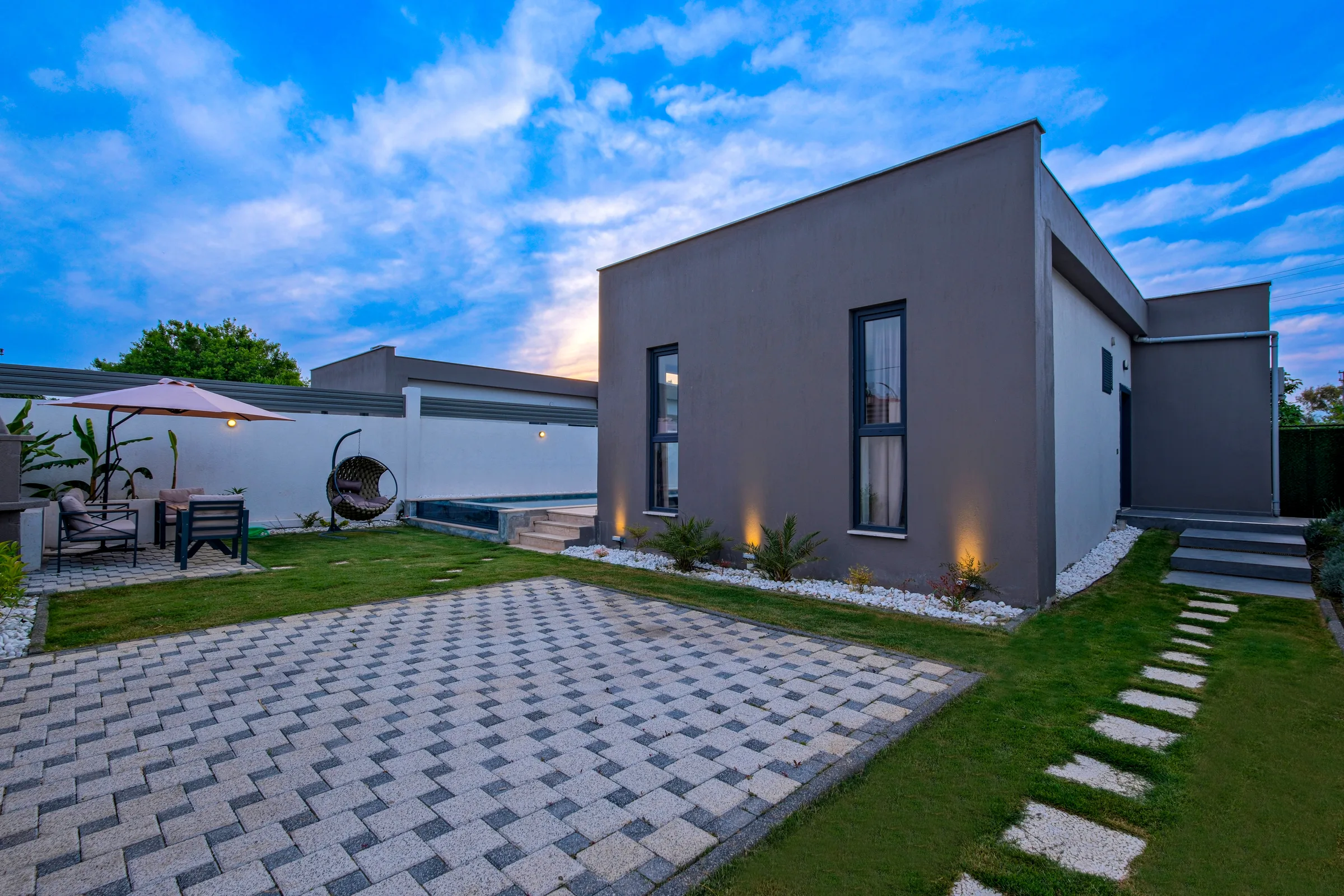
We plan the ground around the house in three bands, working outwards:
- Right against the house: the first few steps along every wall should be non-combustible: gravel, stone, concrete or tiled paving. Bark mulch, dry shrubs, log piles and plastic planters do not belong here.
- The garden: plants in spaced-out groups, watered and pruned regularly. Tree crowns should not touch each other or the roof, and lower branches are cut back so a ground fire cannot climb into the canopy. Dry grass is cut before summer.
- The boundary with the forest: dry grass and fallen branches are cleared. Cutting or heavily pruning trees, especially on the forest edge, may need permission.
3. Planting: keep resinous species away from the house
The dominant tree in Muğla's forests is the Turkish red pine (kızılçam), which is resinous and drops needles that form an easily ignited layer on roofs, in gutters and on the ground. Close to the house we avoid:
- Pine, thuja and juniper, and other dense, resinous trees and hedges
- Reed and bamboo screens, woven sunshades and plastic hedge panels
- Shrubs that hold on to their dead leaves
Near the house, plants with fleshy, moisture-rich leaves and no resin, kept watered, and low ground cover are the sensible choice. Upkeep matters more than species, though: a plant that has dried out will burn whatever it is. Final choices should be made with a landscape specialist for the specific plot; the wider garden decisions are covered in our article on villa gardens and landscaping.
4. Roof, gutters and vents: where embers get in
- Roof covering: clay tiles, metal and flat concrete roofs are non-combustible. The weak points are the edges, so gaps at the eaves and ridge of a tiled roof are closed with metal closure pieces.
- Eaves: on a timber roof, open eaves let embers into the roof space; the underside is boarded with a non-combustible sheet.
- Vents: roof space and eaves ventilation openings are covered with fine metal mesh. Plastic insect mesh melts in the heat and is no help.
- Gutters: built-up needles and leaves make a ready bed for embers. Metal gutter guards and regular clearing are needed, and the space under solar panels is checked too.
- Chimneys: a spark arrester on fireplace and barbecue chimneys also stops sparks from your own fire landing in the garden.
Most of these jobs, pruning, gutter guards and vent mesh, are easily done in the rainy months, well before summer.
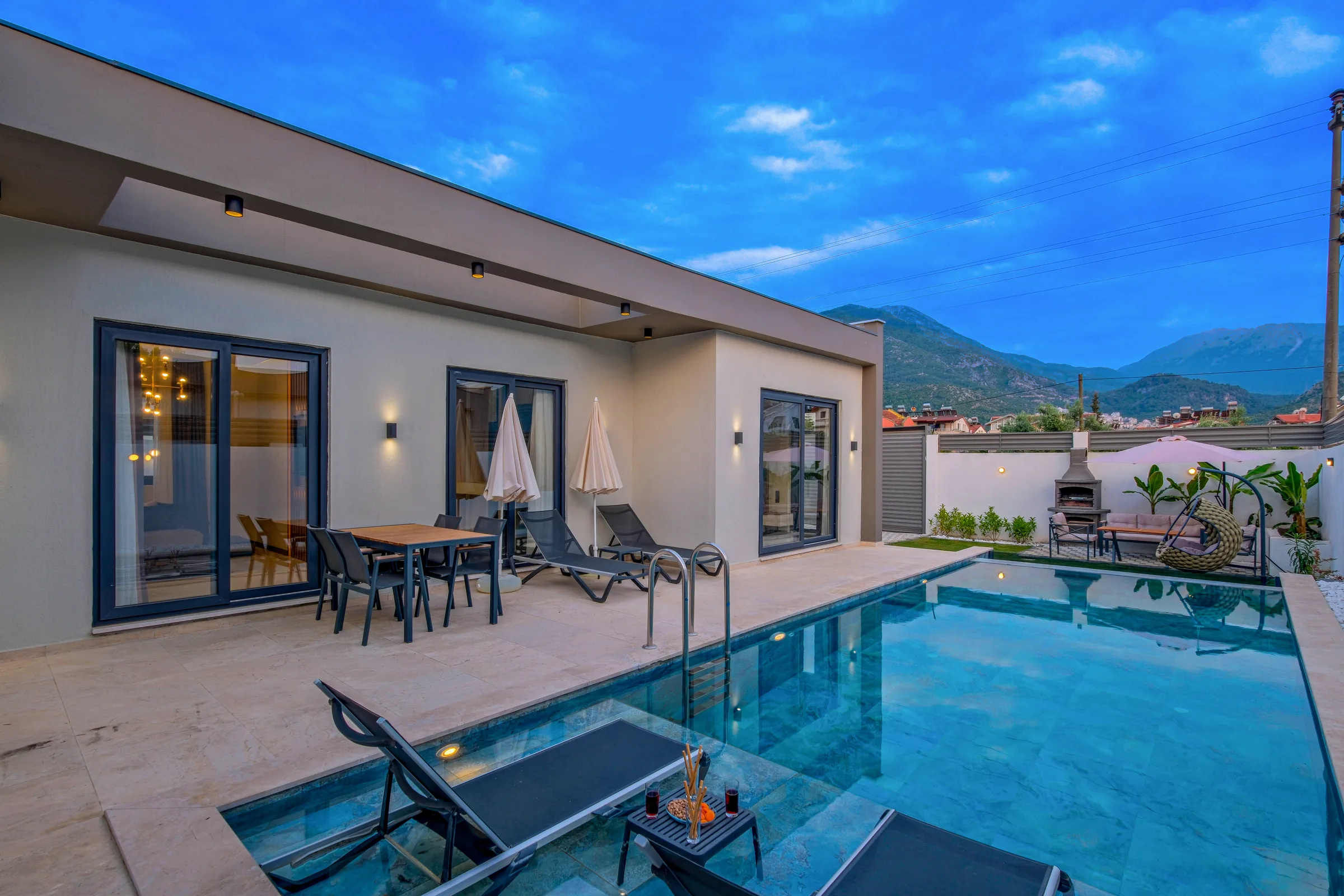
5. Walls, glazing and doors
Render, stone and concrete are non-combustible facing materials; timber cladding and wooden shutters add risk, especially near the ground. If external insulation is planned, the fire classification of the boards should be part of the discussion, and stone wool is non-combustible; the differences are explained in our article on insulation and window choices. Glass can crack and fall out under intense heat, letting fire inside; in double glazing, a toughened outer pane holds up better. Closed metal shutters give the glass some protection from heat and embers. Gaps under doors and around garage doors also let embers in and are sealed with brush or rubber strips.
6. Timber decks, pergolas, firewood and gas bottles
A timber deck or pergola fixed to the house forms a bridge between a burning garden and the building. Stone, tiles or concrete right around the house, and a metal pergola or one standing clear of the walls, break that bridge. If timber is used, keep the space underneath swept and empty rather than using it for storage. Cushions, awnings and parasols come indoors on high-risk days. Log piles should not lean against the house; LPG bottles and generator fuel belong in a ventilated spot, cleared around and set apart from the building, at distances set by the regulations and the supplier. Outdoor materials that cope with sun and salt are covered in our article on materials for Fethiye's climate.
7. Water and fire engine access
- Mains power often goes down during a fire, and a water tank whose pressure pump has stopped is no use. Plan a supply that can run from a generator or by gravity, with hose points that reach every side of the house.
- A pool is an extra source of water, but using it needs a pump and fittings; discuss the details with the fire service.
- Keep a drive wide enough and not too steep for a fire engine, with space for it to turn and leave.
- An electric gate must open by hand when the power is off, and the house number should be readable from the road.
- Plots near the forest boundary may face extra restrictions on building, setbacks and work on trees. We confirm these with the municipality and the local forestry office (orman işletme şefliği) before design begins.
How we read a plot and its surroundings before designing a house is explained on our architect in Fethiye page.
Frequently asked questions
Can I build on a plot next to the forest?
It depends on the plot's zoning status (imar durumu), its relationship to the forest boundary and the views of the relevant authorities. We confirm this with the municipality and the forestry office before any design work starts.
Can I cut down the pine trees around my house?
Permission may be needed even for trees in your own garden, and trees on the forest edge or on land classed as forest must not be touched without it. Ask the relevant office first; in many cases, removing lower branches and opening up gaps between crowns is a realistic place to start.
We let our villa in summer. What should guests know?
Leave clear information about where barbecues may be used, and note that open fires near forests may be restricted in summer by the provincial authorities, so check the current rules. Show where the garden hose, the main water valve and the manual release of the electric gate are, and ask guests to bring cushions in when they go out on windy days.
If you are planning a house on a plot next to the forest, get in touch; we will walk the site with you and work through the layout, garden and materials together.
- orman yangını
- ormana yakın ev
- yangına karşı tasarım
- villa bahçesi
- Fethiye