

· 7 min read
Choosing Materials for Your Fethiye Home: Samples, Mock-ups and Sign-off
Why does a tile you loved in the showroom look different at home? A decision timetable, how to look at samples, on-site mock-ups, written approval and batch differences.
Architect Okan Çakal
A tile that looked perfect in the showroom can look like a different product once it is laid across a floor: darker, busier, shinier than expected. That is rarely bad luck; it usually means the material was chosen in the wrong light, at the wrong scale or at the wrong moment. From our experience on site, choosing materials works when it is treated as a process tied to the order of work on site rather than a single shopping trip, and that matters even more when you are making decisions from another country. Here are the steps and what we look for at each one.
1. Why screens, catalogues and showrooms mislead
The colour on your screen depends on the screen; a catalogue picture is a carefully lit set. Showrooms are often lit with strong, cool light, and the same surface looks different in the warm evening light of your home. A small sample does not tell the whole story either: colour reads stronger over a large area, pattern repeats and tone variation between pieces only show across a few square metres, and grout colour changes the character of a whole wall. Orientation matters too: in a south-facing room the strong light lifts colours, in a west-facing room the late afternoon sun adds warmth, and in a north-facing room the same colour looks cooler and darker. Fethiye's light is bright, and surfaces chosen under grey northern skies often look paler here.
3D images are very useful for proportions and colour relationships; what they can and cannot show is covered in our article on 3D visualisation. The final decision, though, is made with the real material.
2. A decision timetable: what to choose when
Some decisions have to be made long before the finishing stage, because the site depends on them:
- Before first-fix plumbing: concealed cisterns, built-in mixer bodies, shower channels and basin type. Pipe heights and positions are set to match.
- Before the screed: floor finish and its thickness. Tiles, timber and natural stone differ, and door bottoms, thresholds and transitions between rooms are adjusted accordingly.
- Before the electrics: recessed light fittings, the cooker hood and the list of built-in appliances; socket positions and duct routes follow from them.
- Before joinery is made: exact appliance models, sink and handle type. A handleless door changes the cabinet carcass detail.
- After the cabinets are fitted: the worktop size. Worktops are templated on site once the units are in place.
Paint and textiles can come later, but seeing their samples early lets you judge the whole palette together.
3. How to look at a sample
Looking at a sample means more than holding it and liking it:
- Ask for large samples: several tiles side by side, several boards together.
- See them in place: floor samples on the floor, wall samples on the wall; light falls differently on horizontal and vertical surfaces.
- See them in two lights: daylight, and in the evening under lamps of the colour temperature you will actually use.
- See them together: floor, cabinet door, worktop and wall tile side by side.
- Test them: fingerprints on matt surfaces, scratches and reflections on gloss. If the supplier agrees, a drop of lemon juice on a natural stone sample shows the kind of mark you will meet in a kitchen.
4. Mock-ups: testing a big decision on a small area
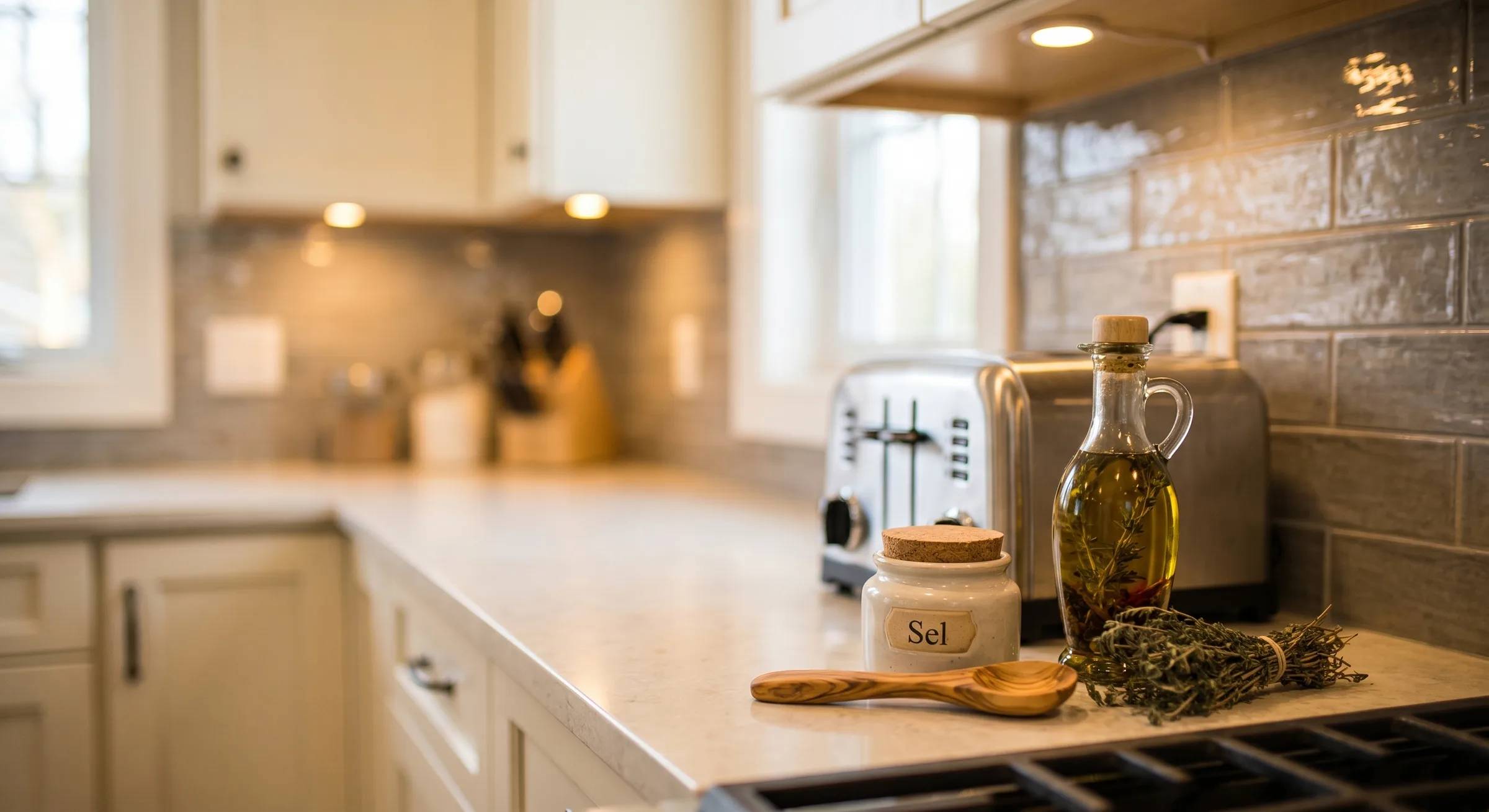
For some materials a sample is not enough. With craft-dependent finishes such as microcement, lime plaster or textured paint, with patterned tiles or unusual laying patterns, and on walls where grout colour and width really matter, we recommend a small mock-up on site: a section of wall, a few rows of tiles, or a door and handle from the bespoke joinery. A mock-up shows not only the colour but the standard of workmanship. Once approved it stays uncovered until the job is finished, and the rest of the work is accepted against it.
An approved mock-up is the yardstick for the rest of the job.
5. Written sign-off: the material schedule
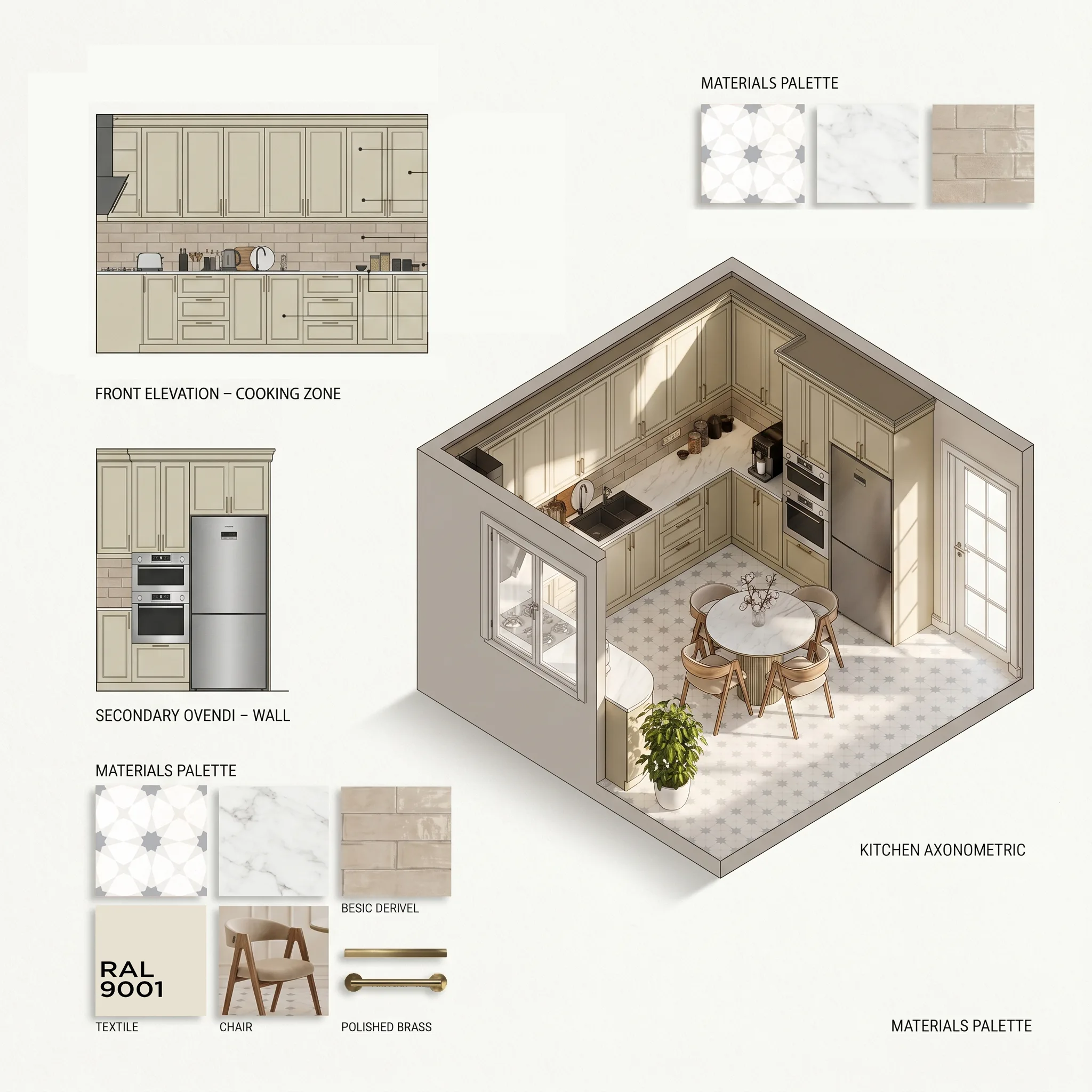
Approval given verbally is open to interpretation on site. Every approved material goes on a schedule with: product and manufacturer, or a definition of an acceptable equivalent; product code; colour code (a standard such as RAL for paint and lacquer); finish (matt, satin, gloss, honed); size and thickness; laying pattern; grout colour and joint width; location and quantity. The approved sample is labelled and kept on site, and deliveries are checked against it.
"Equivalent" needs defining too: same size, same finish, same performance class. Any proposed substitute goes through the same sample and approval step. Because the schedule matches the items in the quote line by line, you can also see what you are paying for. Where it sits within the full drawing set is explained in our article on interior design drawings.
6. Supply: stock, batches and spares
Once approved, ordering begins, and three things matter:
- Lead times and stock: some products are not held locally and come from suppliers in larger cities or from the manufacturer. Confirming stock and delivery dates in writing protects the programme.
- Batches: tiles from different production batches of the same product can differ in shade and calibre. The batch codes on the boxes are checked before laying, and the whole quantity is bought from one batch where possible. With natural stone and timber, variation is part of the material; pieces are laid out side by side and mixed before fixing.
- Waste and spares: cutting waste is allowed for, and a few spare pieces are labelled and stored. Years later, finding an exact match for a broken tile is often impossible.
7. Changes after sign-off
Changing an approved material is possible but has knock-on effects: special orders may not be returnable, a new product's lead time can shift the programme, and a floor finish of a different thickness affects thresholds and doors. So we ask for changes in writing and agree the cost and programme effect before the work is done. For owners abroad, we group selections into one or two visits and take approvals in writing on the material schedule and 3D images in between.
How we handle material selection together with design and construction is explained on our interior design in Fethiye page.
Frequently asked questions
I live abroad. Can I approve materials without being there for every decision?
Yes. We group the decisions that need real samples into your visits, and approve the rest in writing on the material schedule and 3D images. Anything critical, such as a natural stone or a main floor tile, is worth seeing in person.
Can I choose materials from suppliers myself?
Of course. Choosing together lets us check technical suitability, such as size, thickness and performance class, at the same time. Whatever you choose goes on the schedule with its code and finish.
What if the material I chose is no longer available?
We propose an equivalent, which goes through the same sample and written approval step. Any difference in cost or programme is set out in writing before the work goes ahead.
If you would like to choose your materials with real samples and 3D images, get in touch and we will set out the decisions in the order the work needs them.
- malzeme seçimi
- numune
- iç mimari
- tadilat
- Fethiye